Introducing Atlas
Originally published on microagi ↗
The number of robots doing real work in production today, the ones run by learned models rather than handwritten scripts, is somewhere in the low hundreds. Worldwide. The largest single deployment we know of is about a dozen robots.
We know because we went looking. We've spent months on factory floors, including a long stretch in China. The demos are real and getting better every month. The factories are still mostly empty.
Atlas is our product for closing that gap.
The bottleneck is deployment
The ingredients aren't missing. Hardware is getting good and cheap. Models improve every month. But both are arriving for everyone at the same time, so neither stays an advantage. You'll be able to buy them.
What sits between what you can buy and a robot that does one specific job on one specific line, every day, is deployment. Palletizing crates. Tending a machine. Finishing a part. And deployment runs on one thing nobody can sell you: your factory's own manual labour. It doesn't exist in any dataset. It lives in the hands of the people doing the work today. Atlas captures it and turns it into the foundation robots run on.
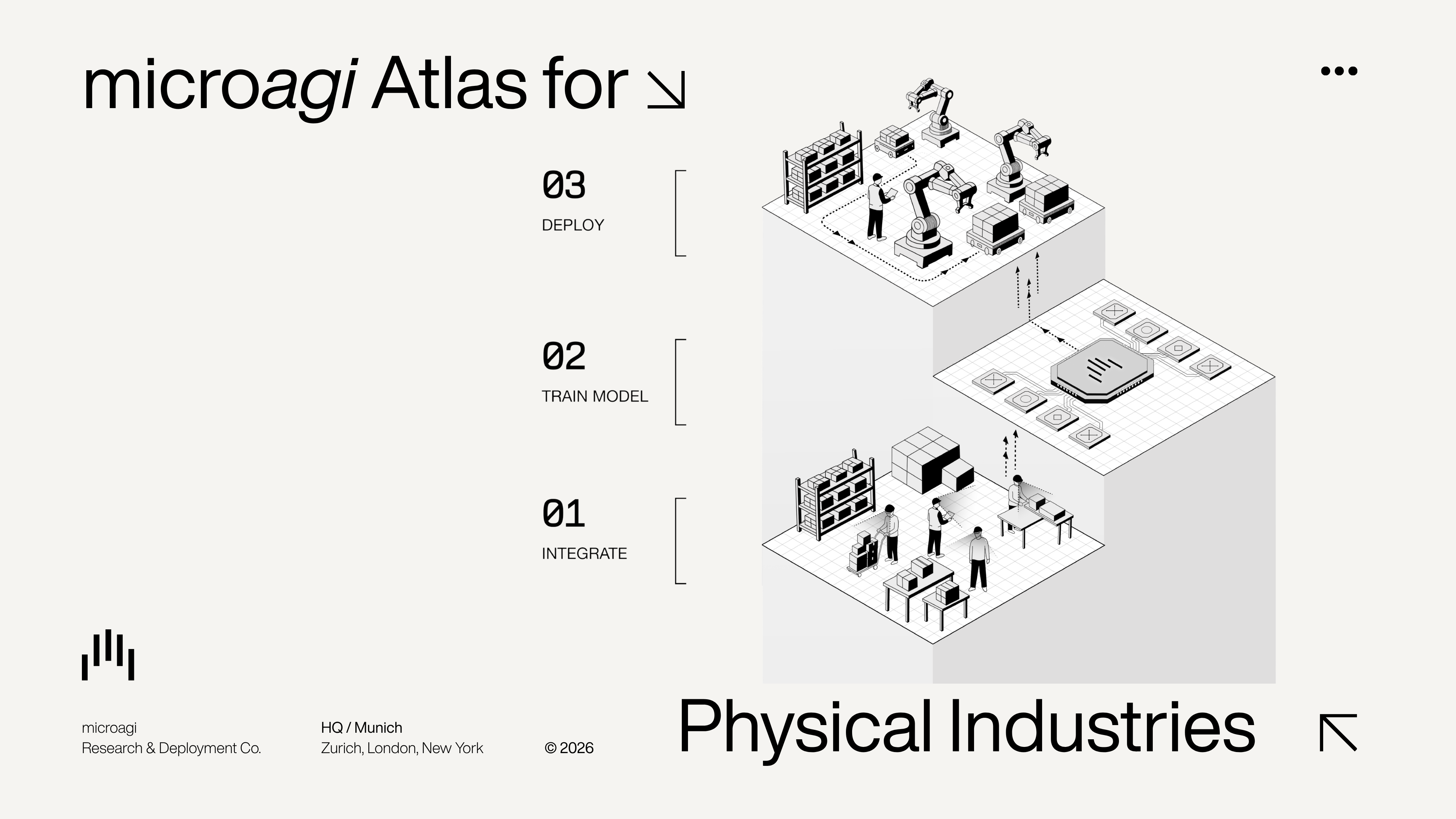
How Atlas works
We don't build robots and we don't build models. Atlas connects the best available model to the best available hardware for a task, and swaps either as the technology improves. A customer isn't betting a production line on one vendor whose product may be outdated in a year.
The process is staged so a customer finds out whether something is feasible before committing much money.
It starts with a scoping study. Our engineers come on site and record how the process is actually done, not how anyone imagines it's done. We run it through our pipeline and come back with clear answers on technical feasibility, the right hardware and its cost from our suppliers, the R&D and operating costs of the project, and the commercial business case. If part of the answer is no for now, we say so and keep looking for the use cases that are feasible today. Hearing that early, before anyone has spent real money, is a large share of the value.
Once a use case clears scoping, the real data collection begins. Our capture hardware records the task from the people who do the work today, in full detail and without interrupting operations. We rebuild the workstation in our workshop in Munich. We buy the hardware ourselves, it stays on our books, and we train the robot there, including deliberately teaching it what going wrong looks like, so it learns the edges of the task and not just the easy middle. The customer carries no hardware risk.
Only when it works in the workshop does it move to the real line. A layer around the model watches for the robot drifting into situations it doesn't understand and stops it. Hard limits govern force, speed and range of motion. Failure gets simulated for many hours before anything touches live production.
And we rent the working system rather than selling a promise. We get paid only if the robot works. For a technology this young, we think that alignment of incentives matters more than anything else we could tell you.
Our proprietary data engine
Atlas works because of the data underneath it. Our proprietary data engine is our record of how physical work is actually performed, collected from real people in homes, farms and factories around the world. It's past one hundred thousand hours and still growing.
We build the capture hardware ourselves and keep revising it: a rig worn on the hip, then multi-camera headsets, then camera glasses, then what may have been the first tactile glove setup in Europe, which records force and not just movement. A pipeline turns video shot from the worker's point of view into training data at scale.
Most deployment shops own no data. Every project starts from scratch. We walk into a plant already knowing a great deal about how physical work tends to look.
Our proprietary data engine gives each deployment a running start. Each deployment produces the one kind of data no general collection contains: how this exact task is done in this exact factory. That data stays with the customer, on European infrastructure, and it makes the next model better and the next deployment cheaper.
Why now
Europe has more high-value manufacturing than anywhere else and a shrinking number of people willing to do the work by hand. The models and hardware just became good enough to try. Almost no one here is organized to do the deployment work at scale.
We don't know yet how fast this scales. We do know the demos aren't the hard part. Someone has to stand on the factory floor until the robot holds up, and that's what microagi is for.