microSLAM: Turning plain monocular RGB videos into interactive RL environments
Originally published on microagi ↗


Updated October 2, 2026: a note on the LaMAria benchmark.
The goal of microagi is to deploy billions of robots worldwide.
Western industry is losing its competitiveness. It is held back by a critical shortage of workers for millions of monotonous and dangerous manual jobs, the jobs that form the backbone of our real economy.
At microagi, we are bringing the value of foundation models to the physical world by building the robotics data and deployment infrastructure, right here in the heart of Europe.
shift records how physical work is performed and turns it into training-ready data without teleoperation or interruption to ongoing operations. Atlas uses that data to train models for specific tasks and carries the right robotic system through deployment and reliable production operation. Together, they create a continuous path from human expertise to deployed robots, and from every deployment back into better data and models.
The deployment advantage
The models will be ready for everyone at the same time. The data won’t.
With us
- 01Project scoping
- 02Data capturing
- 03Model training
- 04Deployment and operations
- 05Competition outpaced
Without us
- 01No data collected
- 02No data collected
- 03Problem realized
- 04Starting from scratch
- 05Outpaced by competition
Announcing microSLAM
Today we are announcing microSLAM, the new state of the art in monocular SLAM from human egocentric video, built by our Zürich-based computer vision team in collaboration with the Computer Vision and Geometry Group at ETH Zürich.
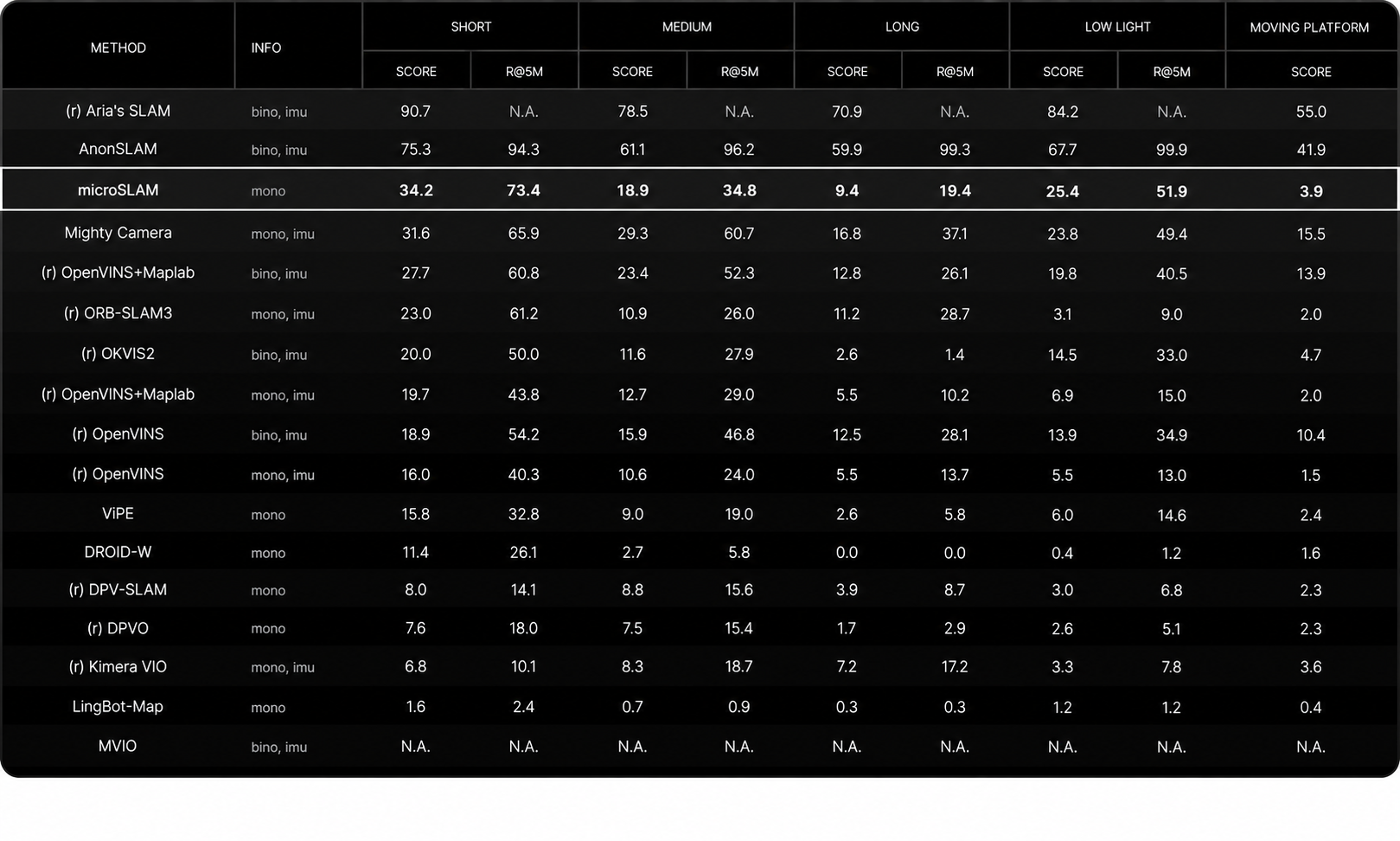
microSLAM ranks first among monocular SLAM systems on the LaMAria benchmark, using a single RGB camera without stereo cameras or an inertial measurement unit (IMU).
#1
Monocular SLAM
on the LaMAria benchmark
on the LaMAria benchmark
1
RGB camera
No stereo or IMU
No stereo or IMU
A note on the LaMAria benchmark
After publishing microSLAM, we found an issue in LaMAria’s scoring system. We reached out to the LaMAria team and worked through it together. The issue affected the control points used during evaluation: they could move during alignment, making some scores look better than they actually were.
The LaMAria team fixed the evaluation pipeline, re-evaluated the affected submissions, and updated the leaderboard. Our scores changed, and the original claims about outperforming Aria SLAM on moving-platform and long sequences no longer apply.
microSLAM remains the best-performing monocular SLAM system on the LaMAria leaderboard. It uses one RGB camera, without stereo or an IMU. That matters to us because monocular capture scales: a worker can record video with a single camera, without carrying a calibrated multi-sensor rig through a factory.
Benchmarks are only useful when they are correct, and research moves forward when results can be challenged and fixed. We are grateful to the LaMAria team for investigating this with us, correcting the evaluator, and updating the leaderboard.
From plain video to interactive RL environments
microSLAM turns plain monocular RGB video into fully interactive 3D environments.
These are so-called reinforcement learning (RL) environments. They teach state-of-the-art behavioral foundation models to understand their surroundings, navigate across factory floors, and become experts at the industrial use cases our clients care about.
Why existing SLAM systems didn't meet our requirements for real robotic deployments
We tried the existing SLAM systems, and they failed for robotics because of three issues.
- The static-world assumption does not hold. Egocentric video is full of motion: hands, people, and objects moving through the scene.
- Scale is ambiguous. A single camera cannot tell the true scale of what it sees.
- Long sequences must stay consistent. Many productive sequences in robotics span tens of minutes, and potentially hours.
ORB-SLAM3, one of the most commonly used SLAM systems, suffers from exactly these three issues. When its estimated poses are fused into a dense reconstruction, accumulated inconsistency remains visible as geometric distortion and misalignment.
For the qualitative comparisons in this article, we keep the camera poses estimated by each SLAM system fixed and fuse the same dense depth source into a truncated signed distance field (TSDF). We back-project each depth map using the corresponding estimated camera pose, accumulate the observations in the TSDF volume, and extract the final mesh. Because the estimated poses are not altered, pose drift and inconsistency remain visible in the resulting reconstruction.
How we designed microSLAM
We tackled these challenges in two key ways.
-
Dynamic-object-aware recognition
microSLAM identifies moving objects in the scene and keeps the static-world assumption intact.
Egocentric RGB video Scene reconstruction by microSLAM -
Robust loop closure
microSLAM uses rich features from the environment to power one of the most robust loop-closure systems to date.
The sales-floor sequence below compares the same scene reconstructed by microSLAM and ORB-SLAM3, making the effect of robust loop closure directly visible.
microSLAM ORB-SLAM3
microSLAM is one of the foundational steps bringing us closer to our goal of deploying billions of robots worldwide.
We will release the microSLAM paper and open-source code in the near future, providing the community with a reproducible foundation to evaluate, extend, and build on this work.