microagi raises $55 million seed round to power Europe’s robotic reindustrialisation
Originally published on microagi ↗
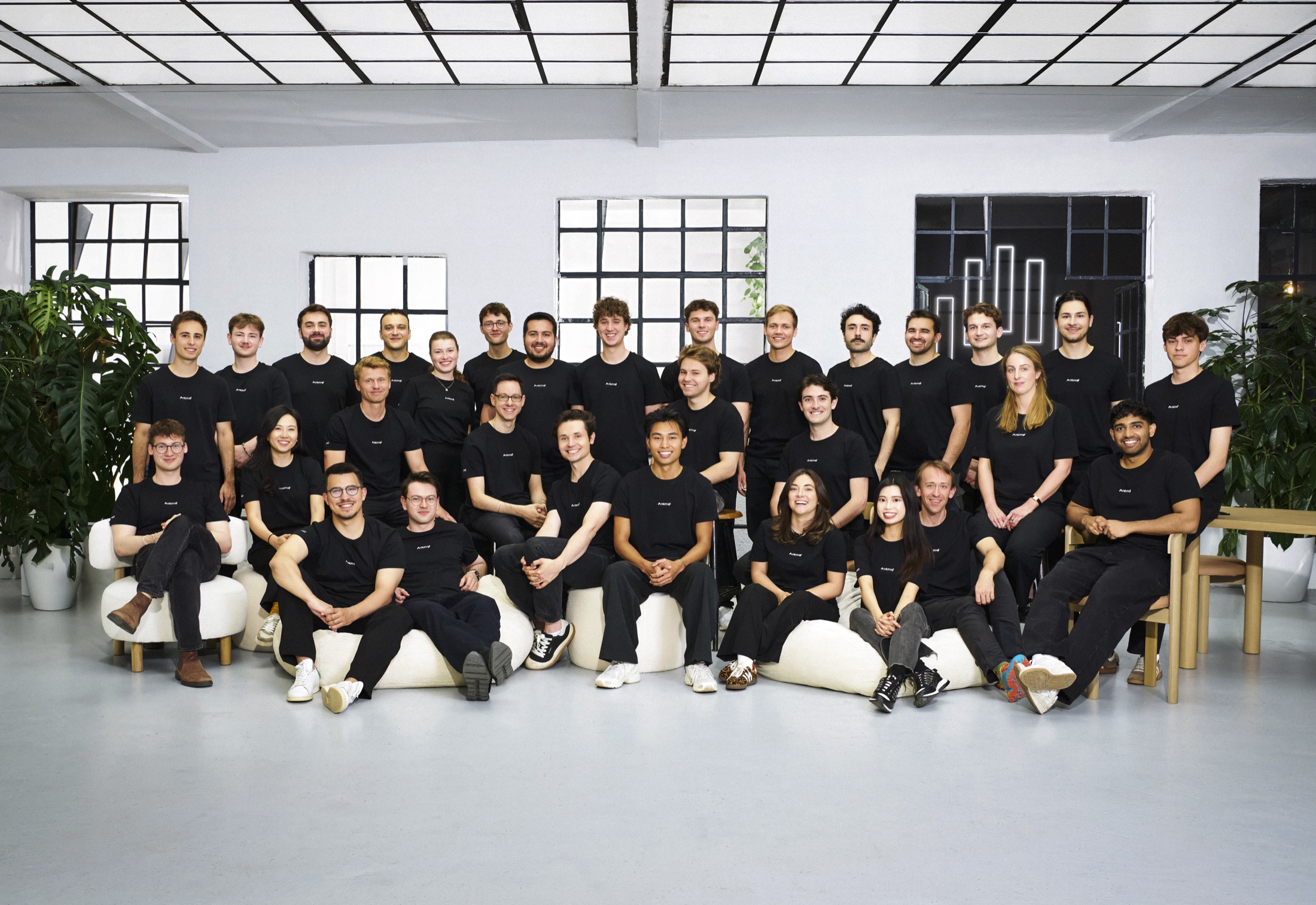
Its platform, Atlas, is the data and deployment layer that helps industrial companies put robots to work faster, more safely and more accurately.
MUNICH, 16 July 2026. microagi, the European robotics deployment company, has raised $55 million in seed funding, the largest seed round in German history. The round was led by Hummingbird, with participation from Northzone, LocalGlobe, Village Global and redalpine. It comes roughly ten months after the company was founded by former Formula 1 engineers from Red Bull Racing and Mercedes-AMG Petronas. The funding will scale Atlas, the company’s data and deployment platform, across some of the world’s largest industrial companies.
The moment
For two centuries, Europe was the industrial backbone of the world. This base is eroding on three fronts at once: output, people and costs. Europe's share of global manufacturing has fallen to 15 per cent, while China's has risen to 30. Nearly 40 million EU workers are over 55, and the knowledge that keeps Europe's factories running retires when they do. And in 2025, the plants that remain still paid more than twice as much for electricity as their US rivals.
The way out is physical automation. China installed 295,000 factory robots in 2024, 54 per cent of the global total; the whole of Europe installed 85,000, or 16 per cent. That gap compounds, because robots share what they learn. A problem solved by one machine is solved for the whole fleet, and the largest fleet learns fastest.
“Industrial Europe has 12 to 18 months to build its robotic edge. We cannot afford to repeat Europe's hesitation on AI,” said Bercan Kilic, founder and CEO of microagi. “If you run factories in Europe, the maths is already on your desk. Your most experienced people retire this decade, and their replacements were never born.”
What microagi builds
Every manufacturer has watched a robotics demo and come away impressed. Almost none has a robot running reliably on the line six months later. Robots get to about 95 per cent of a task and then stall. The last few points, the ones that decide whether a machine actually improves factory economics, come only from that factory’s own operational data and edge cases.
Atlas captures that data inside live production, using dedicated recording hardware and a secure platform built for training-grade data quality and privacy. It then multiplies the data in simulation and fine-tunes the best available model for plant-specific tasks. Finally, forward-deployed engineers and a network of partners, including NVIDIA and Unitree, put the robots on the shop floor. The result is a compounding loop of training and improvement. For the companies that run these plants, the loop translates into lower unit costs, lines that keep running, and no dependence on any single robot maker, model vendor or country’s supply chain.
“Our partners build genuinely good robots and models,” said Nico Nussbaum, CTO of microagi. “Our job starts after that, on the factory floor. We put our engineers on site with each customer, and the system learns from their real operations and feeds that back into the next run, so every month we're there they pull a little further ahead of their competitors.”
Built on legacy
ETH Zurich sits at the centre of the world of robotics research, with the Technical University of Munich close behind. Their laboratories, together with the European research arms of Google, NVIDIA, Apple and ABB clustered nearby, form one of the densest concentrations of robotics and industrial engineering anywhere. For anyone setting out to build physical AI, there is no better place.
microagi has recently opened its global research headquarters in Zurich. It has recruited heavily from both universities, and from DeepMind, Apple and Replit. Yet the people it hires do not fit the usual profile: maths olympiad medallists, physicists who left their studies, rocket engineers, and a striking number who have already founded and run companies of their own.
Its founder and chief executive, Bercan Kilic, came from Formula 1, where he was an engineer at Red Bull Racing. Motor racing is a discipline devoted to making a complicated machine perform reliably under pressure - not a bad apprenticeship for the problem at hand.
“Europe trains some of the best roboticists in the world - then watches them build companies in California. What it has lacked is ambition on a meaningful scale,” said Firat Ileri, Managing Partner at Hummingbird. “microagi has gathered some of the most ambitious people we have met, kept them in Europe, and aimed them at one of the hardest problems there is.”
About microagi
microagi, founded in 2025, is a robotics deployment company. Its platform, Atlas, fine-tunes models on a customer’s own operations, drawing on microagi’s proprietary data corpus, and closes the gap between the robot that impresses in a demo and the robot that does reliable work on the line. Atlas is hardware- and model-agnostic: a neutral layer between a customer’s infrastructure and frontier AI models, designed to prevent lock-in to any single vendor. microagi is headquartered in Munich, with a research hub in Zurich and offices in London and New York.
About the investors
Hummingbird: Hummingbird backs the world’s most unreasonable founders, regardless of geography, vertical, or stage. Since its founding in 2010, the firm has crafted a unique lens for outlier talent to find and fund companies like Lovable, Etched, Kraken, Enveda, BillionToOne and Legora, often as their first institutional backer. Via its growth fund, Hummingbird has invested in future-generational companies like Revolut and Airwallex. Across its global team, Hummingbird’s conviction is that legendary companies come from unreasonable entrepreneurs with the courage and ambition to redefine the future.
Northzone: Northzone is a global venture capital fund that has invested in more than 175 companies, including category-defining businesses such as Spotify, Klarna, Personio, and Trustpilot. Northzone has raised more than ten funds to date, with its most recent fund in excess of $1.2bn. The firm invests from seed to growth stage, with offices in London, New York, Amsterdam, Berlin, and Stockholm.